

Abdul Qadir Imani, a homeowner in Clifton Block 8, came to us with a straightforward request. He had a 5kW on-grid solar system, installed four years ago, running on a 10kW on-grid inverter. Net metering was active. He wanted to add more panels.
The inverter had the headroom. The roof had the space. The request made sense on paper, and most installers would have quoted it the same day.
We advised him not to do it.
Instead, we recommended he spend that money on a hybrid inverter and a battery. He went with it. The system is now running on a SAJ 6kW hybrid inverter with a Sunwoda Atrix 5kWh battery.
This is the reasoning we gave him, and why we think a large number of solar owners in Karachi are about to face the same decision.
The Short Answer
Adding panels to an on-grid system only pays if exporting electricity to the grid pays well. As of 2026, it does not.
NEPRA has moved rooftop solar from net metering to a net billing system under the Prosumer Regulations 2026, replacing the framework that had been in place for a decade. The rate paid for electricity exported to the grid was reduced from Rs. 26 per unit to roughly Rs. 11 per unit. The contract period was also cut from seven years to five.
Meanwhile, the retail rate most residential consumers in Karachi actually pay sits between Rs. 55 and Rs. 65 per unit, depending on slab — a gap of roughly five to one against the export rate.
That single ratio changes the entire logic of rooftop solar. Every unit you send to the grid earns you around Rs. 11. Every unit you use yourself saves you Rs. 55 or more. Producing more surplus is no longer the goal. Using your own production is.
A battery does that. More panels do not.
What Abdul Qadir Imani’s System Actually Looked Like
| Component | Before | After |
|---|---|---|
| Panels | 5kW array | 5kW array (unchanged) |
| Inverter | 10kW on-grid | SAJ 6kW hybrid |
| Battery | None | Sunwoda Atrix 5kWh |
| Grid behaviour | Exports surplus, dies during outage | Stores surplus, runs through outage |
| Net metering | Active, 4 years in | Retained |
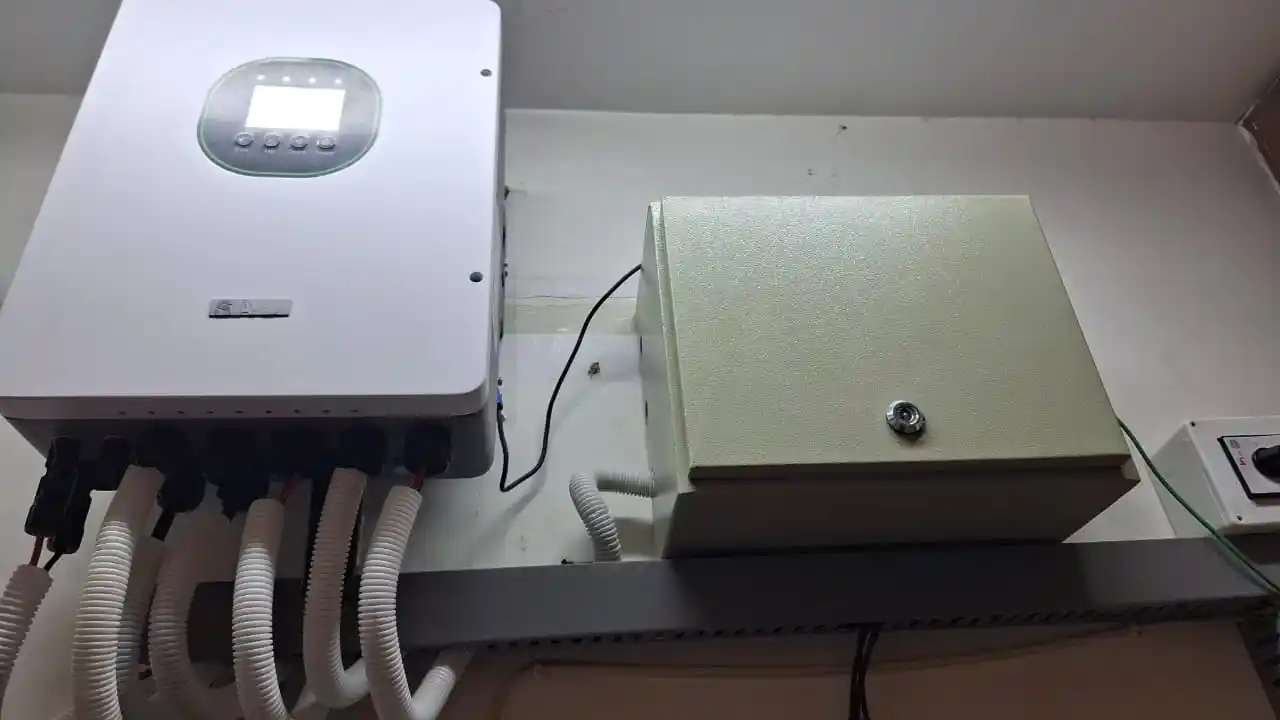
The replacement setup as installed — SAJ 6kW hybrid inverter on the left, AC distribution enclosure alongside it.
Note what did not change: the panels. The array is the same size it was four years ago. The upgrade was entirely on the storage and conversion side.
That is the part most people find counter-intuitive. He spent money on solar and ended up with the same number of panels.
Note also the inverter direction. He went from a 10kW on-grid unit to a 6kW hybrid — a smaller number, deliberately. His household load is around 6kW. The 10kW rating was never doing anything for him; it was headroom for an export strategy that no longer pays. Sizing the hybrid to the actual load, rather than to the old inverter’s rating, kept the cost down and lost him nothing.
The instinct in this market is to make the inverter bigger. Doubling an on-grid inverter is one of the easiest upsells there is, and one of the least useful. A larger on-grid inverter still shuts down during load shedding, still exports at Rs. 11, and still stores nothing.
Why More Panels Was the Wrong Spend
Three reasons, in order of weight.
1. The export rate no longer justifies surplus generation.
The old net metering model worked on a one-for-one exchange. Export a hundred units during the day, import a hundred at night, pay nothing. Under that arrangement, oversizing your array was rational — the grid effectively acted as a free battery.
That arrangement is finished. Under net billing, surplus electricity exported to the grid is compensated at the national average energy purchase price, roughly Rs. 11 to 13 per kWh — about half of what was previously credited.
Adding 2kW of panels to a system that is already exporting means generating more units that now sell at a fifth of what you buy them back for. The payback period on those extra panels stretches out badly.
2. His contract was four years old, and nobody can tell you what replaces it.
This is the argument we kept coming back to, and it matters more than the current rate.
The new policy does not apply retroactively to existing consumers. However, distribution companies have been authorised to either terminate existing arrangements or shift consumers onto the new policy once their contract expires.
His agreement was four years into its term. So the question was never “what does export pay today” — it was “what will export pay when this contract comes up for renewal, and can anyone actually tell me?”
Nobody can. The framework has already been rewritten once. The buyback rate has moved from Rs. 26 to around Rs. 11, and the contract term from seven years to five, inside a single policy cycle. There is no basis for assuming the next revision will be favourable, and no mechanism that guarantees the current terms hold.
Adding panels is a bet that export economics will still be worth something in five years. Adding a battery is not a bet on anything. Electricity you store and use yourself is worth what you would otherwise have paid for it, and that number does not depend on a regulator’s decision.
When the terms are this uncertain, the correct move is to reduce your exposure to them — not increase it.
3. On-grid systems shut down during load shedding.
This is the one people forget. A pure on-grid inverter has no islanding capability — when K-Electric supply goes, the system goes with it, regardless of how much sun is falling on the roof. Adding panels would not have given his family a single minute of additional power during an outage.
He was, in effect, considering spending money to improve a system in the one dimension that had stopped mattering, while leaving untouched the dimension that mattered most to his household day to day.
What the On-Grid to Hybrid Conversion Does Instead
The SAJ 6kW hybrid inverter and Sunwoda Atrix 5kWh battery change the daily energy pattern in three ways.
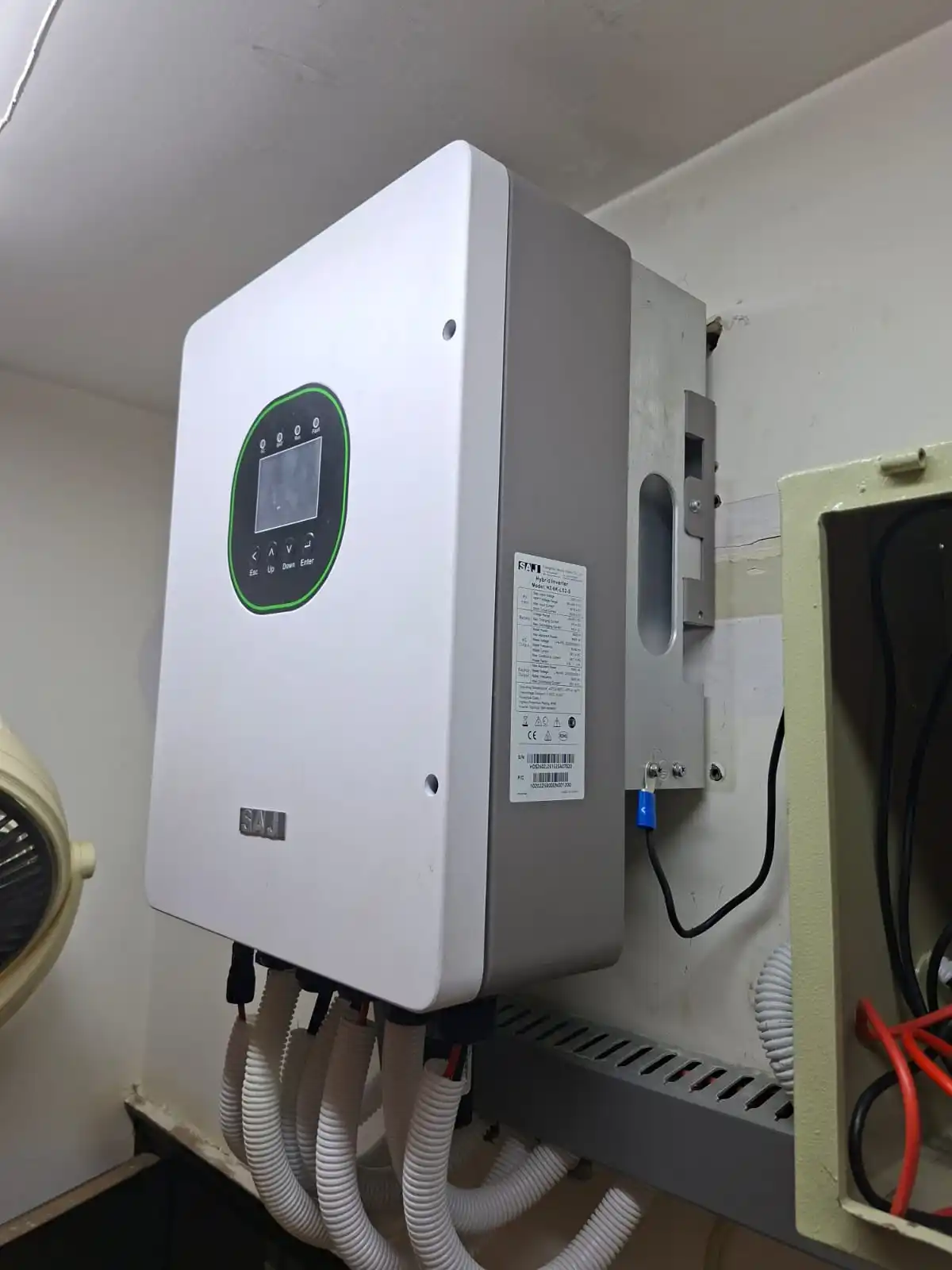
The inverter rating plate — sized to the household’s actual load, not to the 10kW unit it replaced.
Morning and midday: production is stored, not sold. The array generates its peak output between roughly 10am and 3pm, when household demand is at its lowest. Previously that surplus went to the grid at the export rate. Now it charges the battery first, and only genuine excess goes out.
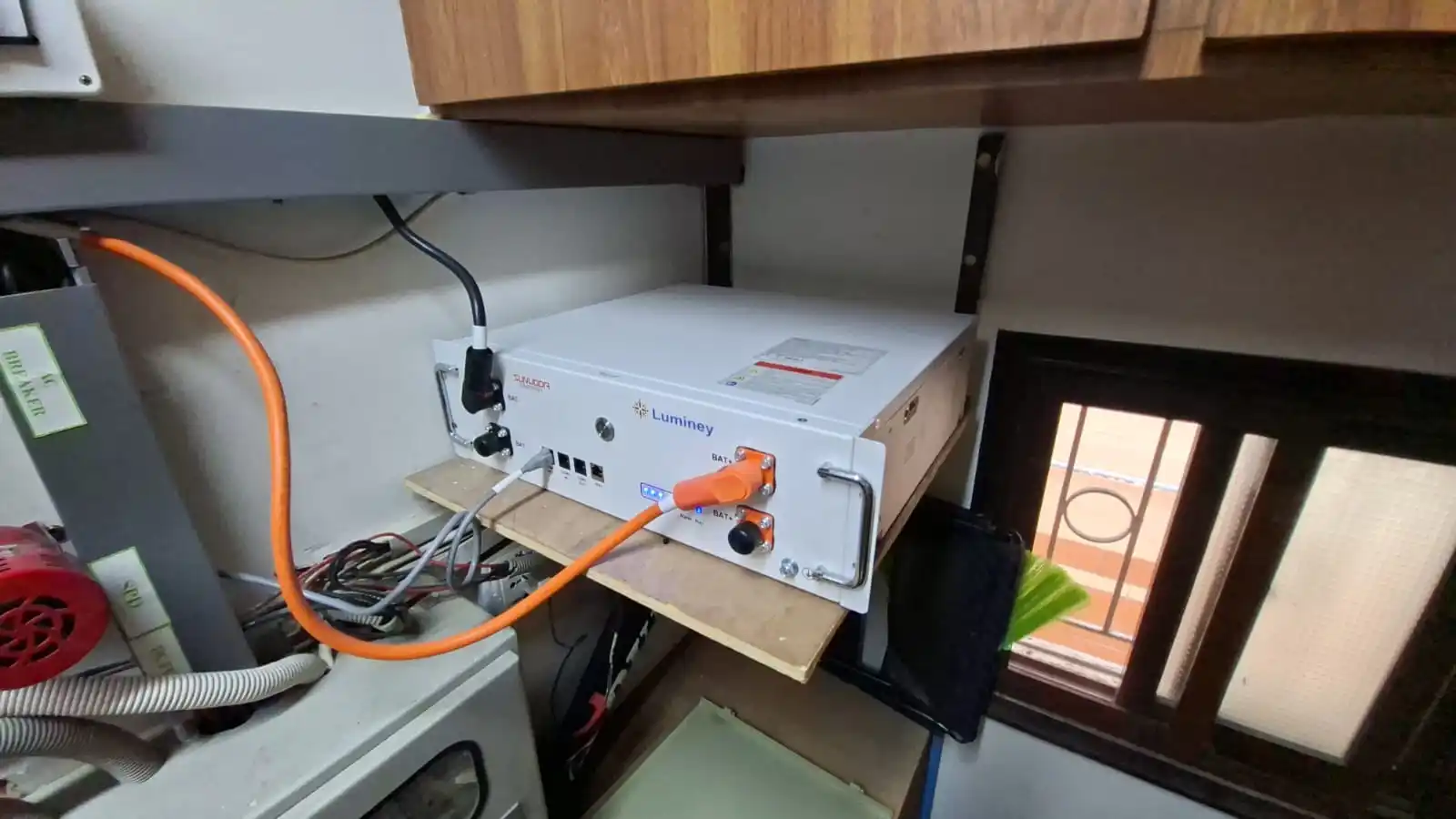
The Sunwoda Atrix 5kWh battery — daytime generation charges this instead of being exported at Rs. 11 per unit.
Evening: stored energy replaces expensive grid units. Household load peaks in the evening — air conditioning, lighting, kitchen. These are also the hours when grid consumption is most expensive. The battery discharges into this window instead of the household importing at Rs. 55 to Rs. 65 per unit. Internationally this is called peak shaving; the mechanism is simply moving your own cheap production into your own expensive consumption hours.
During load shedding: the house keeps running. The hybrid inverter isolates from the grid and continues supplying the home from panels and battery. This was the single benefit the client felt immediately, and the one his family noticed first.
Net metering was retained through the conversion. Hybrid inverters remain compatible with net metering because they stay grid-connected while managing battery storage — for K-Electric approval, the inverter must meet IEC 61727 and IEC 62116 standards. The client did not give anything up. He added a layer.
Is This Relevant to You, or Was It Specific to This Case?
It is not specific to this household. It is arguably the most common situation in Pakistani rooftop solar right now.
Pakistan crossed 6 GW of net-metered rooftop capacity in 2025, with over 283,000 registered net-metered consumers nationally. Almost all of that capacity was installed under the old one-for-one exchange, by owners who sized their arrays for export.
Every one of those systems is on a contract with an expiry date. Every one of those owners will, at some point in the next few years, be asked to renew under terms that pay a fifth of what they were promised.
If you own an on-grid system installed between 2021 and 2025, the question in front of you is not whether to add panels. It is what your system should look like when your current contract runs out.
What an On-Grid to Hybrid Conversion Costs in Karachi
We are not going to print a price here, and the reason is worth stating plainly: hybrid inverter and battery costs in Pakistan move with the exchange rate and shift week to week. Any figure published today would be wrong by the time you read it, and a number that is wrong is worse than no number at all.
What we can tell you is how the cost is structured. The battery is usually the larger share of the spend, and it scales with capacity and cell chemistry. The inverter is the smaller share, and it should be sized to your actual household load rather than to your existing inverter’s rating — as it was in this case, where a 10kW unit was replaced with a 6kW one.
For a current figure on your specific setup, ask us directly and we will quote against what is on your roof today.
Two honest caveats before you decide:
Conversion is not always the right call. If your household consumption is genuinely low in the evening, if you are rarely home during peak hours, or if your area sees little load shedding, the case weakens considerably. A battery earns its keep through daily cycling. If it does not cycle, it is expensive hardware sitting idle.
Your existing inverter may or may not be reusable. In this case the 10kW on-grid unit was replaced, not retained. Some setups allow an AC-coupled retrofit that keeps the original inverter in place. Which route applies to you depends on your wiring, your array configuration, and your load profile. It needs to be looked at, not assumed.
Frequently Asked Questions
Will I lose my net metering if I convert to hybrid?
No. Hybrid inverters stay grid-connected and remain eligible, provided the unit meets the required IEC standards for K-Electric approval. Abdul Qadir Imani retained his connection through the conversion.
Is net metering finished in Pakistan?
The one-for-one exchange is finished. NEPRA has replaced it with net billing under the Prosumer Regulations 2026. You can still export, but you are credited at roughly Rs. 11 per unit rather than at retail rate.
Does the new net billing rate apply to my existing solar system?
Not immediately — the policy does not apply to existing consumers. But distribution companies can move you onto the new terms once your current contract expires. Check the remaining term on your agreement before making any investment decision.
Should I add more panels or add a battery?
If your bills are driven by evening and night consumption, or if load shedding affects you, a battery. If you have a genuinely large daytime load that your current array cannot cover — a workshop, a commercial premises, daytime air conditioning — more panels may still make sense. The deciding factor is when you use electricity, not how much.
Can Raj Solar convert a solar system that another company installed?
Yes. We assess the existing array, inverter, wiring, and net metering agreement, then recommend what should be kept and what should be replaced. Retaining serviceable equipment keeps the cost down, and we would rather do that than sell you hardware you do not need.
The Point of This Case Study
We could have sold him four more panels. It would have been a faster sale, a simpler job, and he had already decided he wanted it.
It would also have been the wrong advice, and he would have discovered that when his contract came up for renewal.
The economics of rooftop solar in Pakistan changed in February 2026. A system designed to sell electricity to the grid is now a system designed around an assumption that no longer holds. The systems that will perform well over the next decade are the ones built to consume what they produce.
There is a simpler way to put it. A system that exports is dependent on whatever the grid decides to pay for its electricity. A system that stores is not. In a market where the rules have already been rewritten once and may be rewritten again, that independence is the actual asset — more than any individual number in the tariff notification.
If you have an on-grid system and you are wondering what to do with it, that is a conversation worth having before your contract expires rather than after.
Raj Solar designs, installs, and upgrades solar systems across Karachi. If you want your existing setup assessed against the current net billing rules, get in touch and we will walk you through the numbers for your specific case.